What You Actually Need to Start Journaling (Without Buying Everything)
My honest journaling supplies for beginners, after three weeks of actually using them
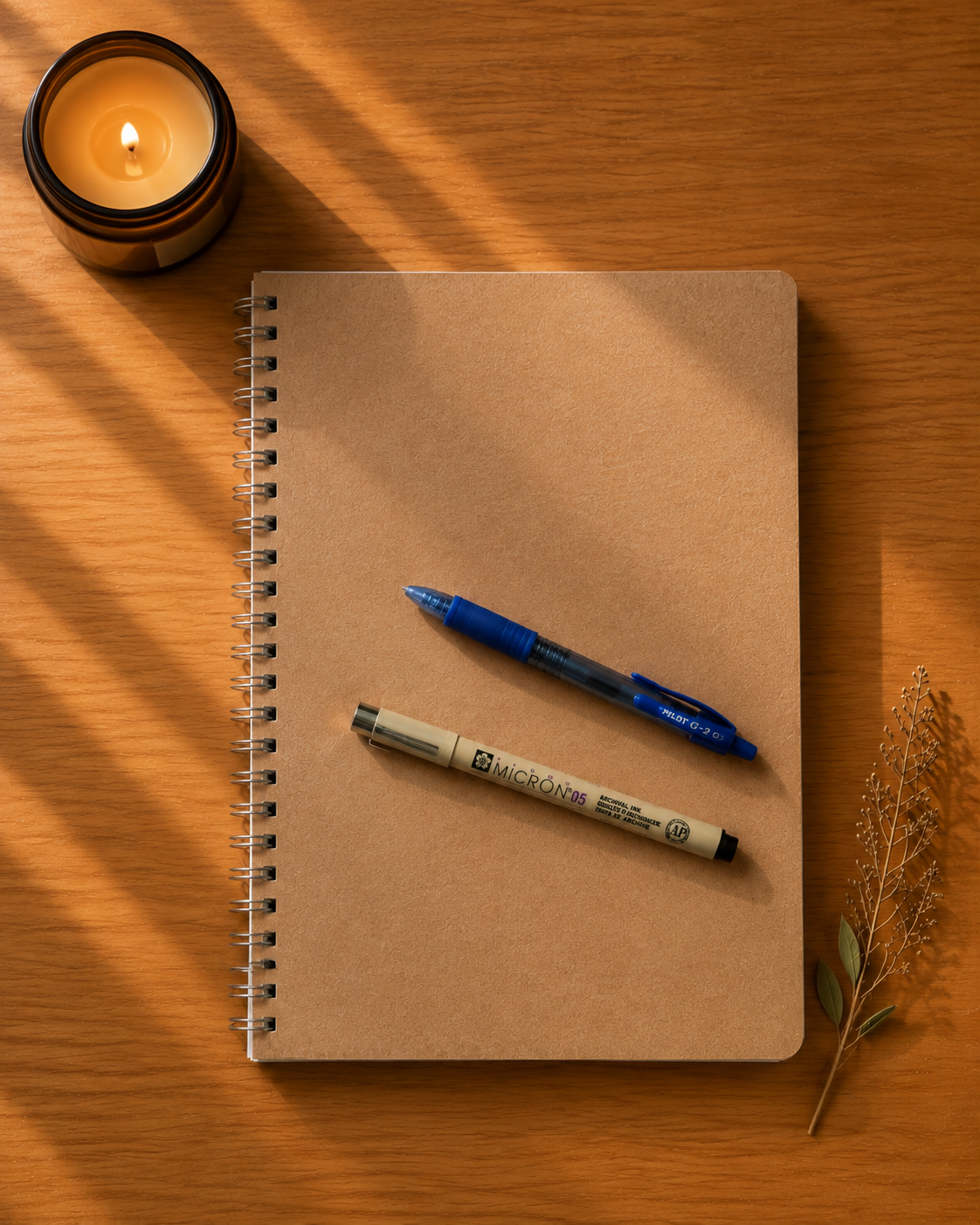
If you've been searching for what you need to start journaling, you've probably found lists recommending expensive notebooks, fountain pens, stickers, washi tape, and every accessory imaginable.
I read those lists too. Before I started journaling, I spent more time researching notebooks than actually writing in one — somewhere between comparing paper quality and reading pen reviews, I'd turned a simple habit into another project that needed planning.
So I stopped researching. I bought an inexpensive notebook because it came as a pack of two on Amazon, picked up a Pilot G2, and used a Sakura Micron I already owned from drawing. That was my entire setup.
Three weeks and about twenty pages later, here's the short version: a notebook you're happy to use, one pen you genuinely enjoy, and permission to write imperfectly. Everything else can come later.
The Supplies I Actually Used
Product - Why I chose it, Would I buy it again?
Generic notebook - Chosen for being inexpensive, came as a pack of two. Probably not this exact one again.
Pilot G2 0.7mm (Blue) - Wanted one reliable everyday pen. Absolutely would buy again.
Sakura Pigma Micron 0.5 - Already owned it, for drawing. Nice to have, not necessary.
Do You Need a Special Notebook?
No — and I think starting with an ordinary one actually helped.
The notebook I've been using isn't a brand I could name without checking my order history. I bought it because it was cheap and came in a pack of two. After twenty pages, here's what I've noticed: the paper is thinner than I'd like, and pressing hard leaves an impression — some ghosting — on the next page. I noticed it constantly the first couple of days. By week two, I'd stopped.

Because it wasn't expensive, I never felt nervous about using it or worried about making every page look nice. The notebook became less important than the practice itself — that was the biggest surprise. If you're wondering whether to buy something premium before starting: save the money. Use what's in your drawer. Your first journal doesn't need to be a keepsake. It just needs to become a habit.
Is the Pilot G2 Worth It?
Out of everything, this is the one I'd recommend without hesitation. I use the 0.7mm in blue, and it's what I automatically reach for. I didn't compare ten pens — I just needed one that worked, and it quietly earned its place.
It writes smoothly, the grip holds up over longer entries, and — as someone left-handed — the ink starts clean instead of leaving a blob on the first letter that my hand then drags into a smudge. Small detail, but one less thing pulling my attention away from writing. The only real note: buy refills, because you'll likely keep using it.
Do You Need a Second Pen?
Probably not. The Sakura Micron 0.5 sits on my desk, but I didn't buy it for journaling — I already owned it for drawing, and most days I don't touch it. When I do, it's to sketch a small leaf in the margin, underline a sentence worth returning to, or write the date differently. It's less a journaling essential and more a small creative ritual. If you already own one, you'll find uses for it. If you don't, the G2 is more than enough to start.
What Actually Changed After Three Weeks
I thought I needed better supplies. What I actually needed was to stop waiting.
I imagined journaling every morning at the same time — that never happened. Some days I wrote twice, some days I skipped three in a row, and that turned out to be fine. I stopped measuring entries too: some filled two pages, some filled two lines, some were just complaints about my day or the weather.
One afternoon, walking home from a nearby shop, I caught myself mentally composing a journal entry. It sounded exactly like something I would have written down — the only difference was that if I didn't write it, it would disappear. That was when journaling stopped being something that happened only in the notebook and became a way of noticing my own thoughts. I also stopped trying to write the "right" thing. Some entries are reflections, some are word vomit, some barely mention me at all. None of them are perfect. All of them are honest, and that's what's kept me coming back.
If you're waiting for the perfect supplies before you begin, start with what you already have. The practice grows faster than the shopping list ever will.
Some days it's a rant. Some days it's two lines. Some days it's about the weather. All of it counts.
If a blank page still feels intimidating: the 7-Day Slow Start Kit gives you one gentle prompt for each of your first seven days — less time wondering what to write, more time actually writing.
Explore the 7-Day Slow Start Kit →
Quick Recap
What you actually need to start journaling:
A notebook you're happy to use
One reliable pen you enjoy writing with
Permission to write imperfectly
Everything else can come later.
Where This Goes Next
One of my favourite entries so far is the one I wrote the day Slowly Curated finally went live. It's not my favourite because the writing is beautiful — it's my favourite because it's real. That's probably what journaling has given me more than anything: I started worrying about notebooks and pens, and somewhere along the way I stopped performing for the page and just wrote whatever was there.
If you reach that point too and want a little more structure, that's what the Month 01 Journaling Kit is for — 30 prompts, a simple Presence Tracker, and gentle guidance to continue the practice without taking away the freedom you've already found.
Explore Month 01 Journaling Kit →
Continue the Slow Study
Join The Slowly Letter — every Friday, what I'm learning during each month's Slow Study, plus reflections that don't always make it into the blog.
Wherever you're starting—whether it's a school notebook, a half-used diary, or the journal you've been saving for the "right moment"—I hope today is the day you write the first page.
— Slowly Curated
