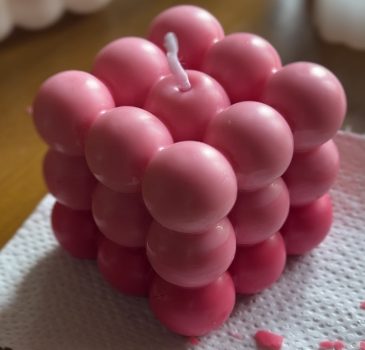
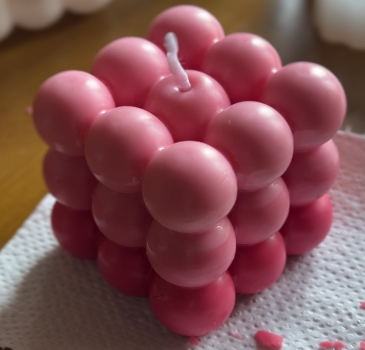
I wanted to make an ombré bubble candle.
I’d seen candles with layers of colour, gradually changing from light to dark, and I wanted to try one myself. It looked pretty, and I liked the idea playing with colours. After my first candle, I was also secretly relieved that I wouldn’t have to worry about jump lines on rhe sides of a glass jar this time.
I had a picture in my head of how I wanted it to look: three layers, different shades of the same colour, blending into a little gradient.
It seemed simple enough. At least, simpler than my first attempt.
But I’ve started to realise that there’s often a difference between imagining how something will turn out and actually making it.
A little more confidence this time.
This time, I knew a little more about what I doing.
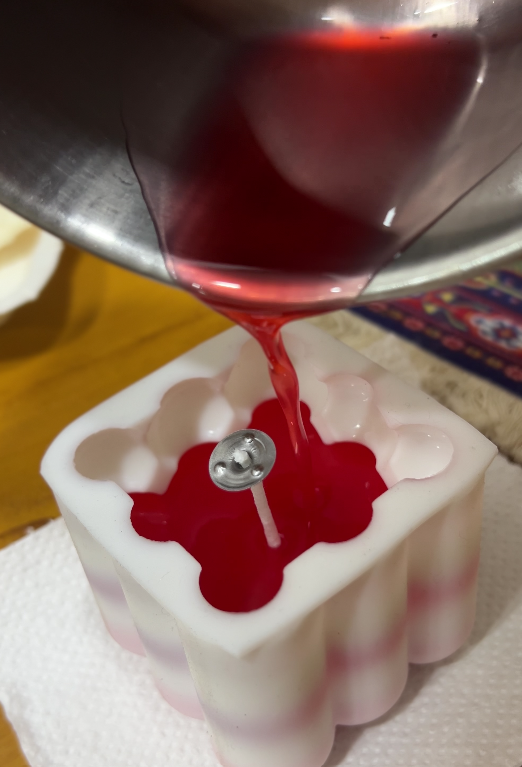
I’d already made one candle, so I had a better idea idea of how much wax I’d need and how the colour might turn out. I was still working without a thermometer, but I was more careful about not letting the wax cool too much before pouring.
I also decided to skip the fragrance. Since I was working with three separate layers, I thought I’d simplify things where I could.
I melted the wax one portion at a time, starting with the lightest colour and gradually moving towards the darkest.
The first layer went well. I was happy with the quantity and the colour, and it was satisfying to see the candle slowly take shape.
Then I noticed something.
The wax had spread slightly towards the next layer on one side. The surface I’d assumed was level wasn’t quite level after all. It was a small detail, but I adjusted it before moving on.
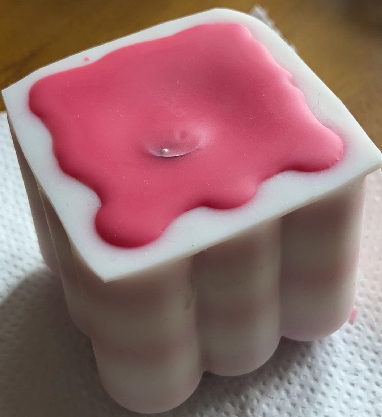
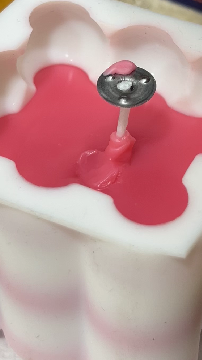
The second layer went in, and by the time I was ready for the third, I noticed that the wick was slightly off-center.
I could have left it alone.
Instead, I tried to straighten it.
The wax looked set on the surface, so I assume it would be firm enough to hold its shape. But when I moved the wick, it shifted much more easily than I’d expected.
The top had started to solidify, but the wax underneath was still soft.
I immediately worried that I’d distributed the layers I’d just poured.
There wasn’t much I could do at that point, so I continued with the final layer and left the candle to set overnight.
The part I thought would be easy
The next morning, I was excited to see how it had turned out.
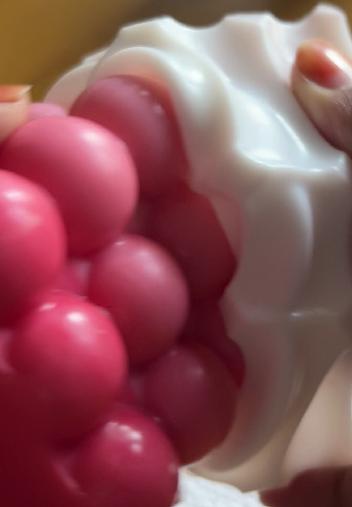
Until I tried to removed it from the mould.
I’d assumed that once the wax had cooled, the candle would come out fairly easily. Instead, I had to stretch the mould, pull at it, and turn it around until the candle finally came free.
The wax was softer that I expected, too. I wasn’t sure whether that was simply how this soy wax behaved or whether I’d done something wrong. It was my first time making a candle in a mould, and I was still figuring things out.
And then, while trying to get it out, I scratched the second layer with my fingernail.
My immediate reaction was to fix it.
Of course.
I’d already spent time measuring the wax, mixing the colours, pouring each layer and worrying about the wick. And there I was, trying to correct a tiny scratch before I’d even finished looking at the candle.
I wanted to make it right.
Not necessarily perfect, but close to the picture I had in my head.
A little question for you, Slowling:
Have you ever made something and found yourself fussing over a tiny detail that probably wouldn’t matter to anyone else? I’d love to know what you were making.
Why did I keep interfering?
While thinking about the candle, I remembered something from September’s herb gardening slow study.
My coriander seedlings had started growing, and I kept checking on them. When the stems leaned, I wanted to do something about it. I found myself intervening instead of simply watching what happened.
I seem to have done something similar with the candle.
The wick was slightly off-center, so I moved it. The candle had a scratch, so I tried to fix it. Whenever I noticed something that didn’t look quire right, I wanted to do something about it.
I don’t know why I do this.
Perhaps it’s because I want what I’m making to resemble the picture I have in my head. Maybe I find it difficult to leave something alone when I think I can improve it.
Or perhaps I’m still learning when to intervene and when to let things be.
I haven’t figured that out yet. But I found it interesting that the same impulse appeared in two completely different activities: growing coriander and making a candle.
I started October wondering what makes something worth making. I hadn’t expected to find myself noticing these little habits along the way.
And then, I looked at what I had made
Once the candle was out of the mould, I looked at it from all sides.
I checked the layers, looked at the shape and noticed the little imperfections.
Then I left it where it was.
I didn’t spend the rest of the day admiring it. I simply went about my day, and the candle stayed where I had placed it.
But sometimes, when I pass by it, I stop for a moment.
I made this.
I think part of what makes that moment special is that, before I started, this candle existed only in my imagination. I had pictured the colours, the layers and how it might look when it was finished.
Now, it’s sitting right there.
It might not have turned exactly as I had imagined. I can still see little things I’d like to improve. But none of that changes the fact that something I pictured in my mind is now something I can hold in my hands.
And I made it.
I could have bought a candle instead. It would have been quicker and easier.
But then I wouldn’t have this particular feeling of looking at something and remembering that it began as an idea, and that I brought it into the world, one layer at a time.
Maybe The process doesn’t have to be perfect.
I’m not coming away from this experiment thinking that I should stop caring about how things turn out.
I enjoyed choosing the colours and watching the layers take shape. I wanted the candle to look a certain way, and I still want to learn how to make better ones.
But I’m beginning to wonder what happens when the expectation of getting something right starts taking up space that could have been used to enjoy making it.
I don’t have an answer yet.
I know that I want to experiment more. I know I’ll probably keep noticing things I’d like to improve. And I’m sure there will be more mistakes along the way.
Maybe I can learn to leave a few things alone, too.
To let something be slightly imperfect without immediately trying to correct it. To finish making something before deciding what I think of it. To appreciate what I’ve made, even when it doesn’t quite match what I imagined.
For now, I’m still learning.
And there are more candles to make.
Maybe the next one will turn out differently. Maybe I’ll make the same mistakes again. Either way, I want to pay a little more attention to what happens between imagining something and bringing it into the world.
Because this month’s Slow Study isn’t only about learning to make candles. It’s also about discovering what the process feels like, what I learn along the way, and whether the time I spend making something feels worthwhile.
I’m curious to see what I’ll learn next.
A little note before you go
This is part of Slow Study 03: What is Worth Making? — One ordinary practice explored with full attention for a month.
I’m documenting the experiments, the things that go wrong, and the little things I discover along the way.
If you’re curious about what happens next, follow along with Slowly Curated. There’s more candle making ahead.
